
Increase productivity without running faster
For production management: reduce machine downtime, shorten changeover times, reduce scrap and rework
In production management the same question comes up every day: how do more good parts come off the line without additional machines, additional staff or additional budget?
Experience shows: the reserve rarely lies in the cycle time. It lies in the losses. Unplanned downtime interrupts the flow, long fault repairs eat up production time, and scrap costs material, energy and working time without producing a saleable part.
That is why it is worth looking at three fields of action: avoiding downtime, fixing faults faster and reducing scrap and rework.
OEE shows where the time goes
Overall equipment effectiveness (OEE) is the central KPI of production. It makes all three types of loss visible in one number:
Availability × performance × quality = OEE
An example: a system reaches 90 percent availability, 95 percent performance and 98 percent quality. The OEE is therefore 0.90 × 0.95 × 0.98 = 83.8 percent.
If availability rises by just three points to 93 percent, the OEE is 86.6 percent. With the same crew on the same machine. Anyone who wants to raise OEE therefore almost always starts with availability.
What that means in euros is shown by the worked example on the home page: there every hour of downtime costs 2,800 euros.
1. Avoid downtime before it happens
The best fault repair is the one that is not needed at all. The prerequisite is not to accept recurring failures as everyday life.
Anyone who wants to reduce machine downtime needs an honest evaluation of the fault messages. Which fault happens most often? Which costs the most time? Building on that, maintenance intervals are adjusted, wear parts are replaced in time and operators are trained to spot deviations early.
What matters here is the difference between fixing a fault and eliminating its cause. If the same fault comes every week, the system runs again after every repair. But the cause remains.
2. Fix faults faster
If downtime cannot be avoided, every minute counts. Besides the repair itself, waiting times often arise: maintenance is notified too late, the right drawing is not at hand, the experienced colleague is in another hall.
Clear reporting paths, defined responsibilities and available spare parts are the basis. But diagnosis has the greatest leverage.
3. Reduce scrap and rework
A fault is only fixed once the system produces with stable quality again. Changed temperatures, adjusted parameters or an untidy restart otherwise mean the machine runs but produces scrap.
Reducing scrap means:
- Record faults precisely: by product, system, shift, process step and fault pattern.
- Search for causes in a structured way: for example with the 5-why method or an Ishikawa diagram.
- Secure process parameters: Define, monitor and protect critical settings against unintended changes.
- Standardise the restart: After downtime or a product changeover, fixed check and release steps apply.
The earlier a deviation is detected, the less material and working time is in the faulty part.
The three fields belong together
An unstable machine often causes both: downtime and quality problems. A poorly documented fault leads to a long repair and afterwards to scrap again.
That is why the three fields do not belong in separate projects but are tackled together with maintenance and quality assurance. At the start are not twenty small measures but the one cause that costs the most.
More output does not come from people working faster but from less time being lost. Then not only the available production time rises but also the quantity that can actually be sold.
The right KPIs
A few meaningful KPIs are enough to make improvements measurable:
| KPI | What it shows |
|---|---|
| Unplanned downtime | How much production time is lost to failures |
| MTBF (Mean Time Between Failures) | How often a system fails |
| MTTR (Mean Time To Repair) | How long it takes until it is restored |
| Scrap rate | Share of faulty parts in the production quantity |
| First Pass Yield (FPY) | Share of parts that are good without rework |
| OEE | Availability, performance and quality in one number |
No KPI stands on its own. A falling MTTR is good but says nothing about whether the number of failures is going down. Only together do they give an honest picture.
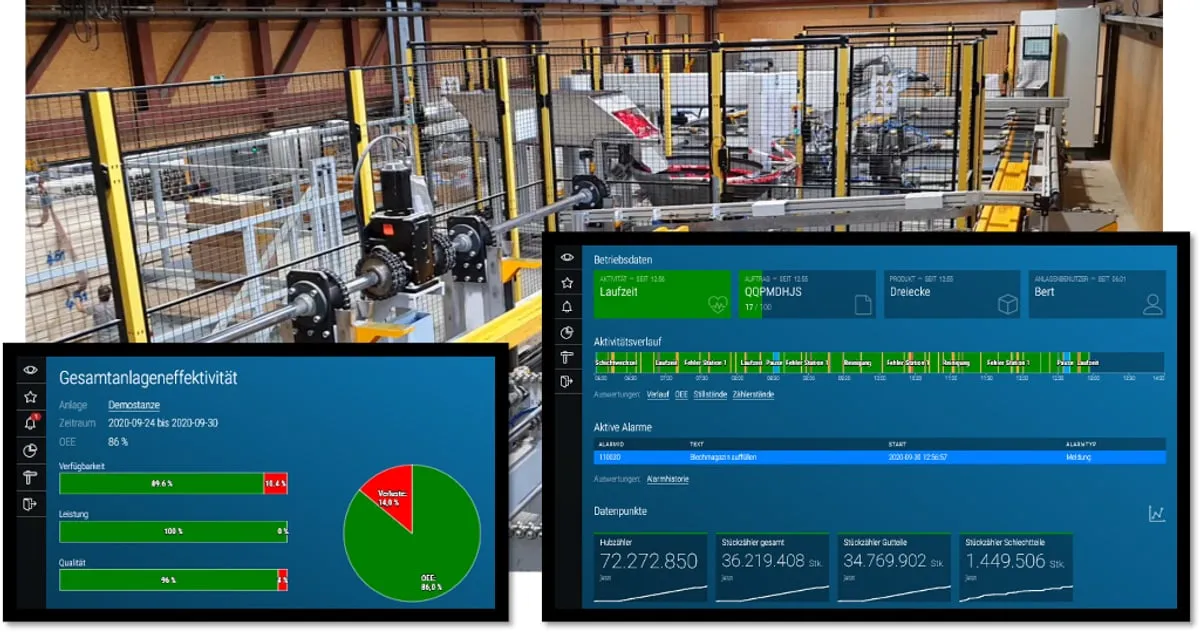
BDE with OEE: downtime and key figures at a glance
So that downtime and OEE do not have to be estimated, a production data acquisition (BDE) system is needed. With digifai control, also from Eberle, machine data is recorded automatically from the controller, orders and organisational downtime are added, and the OEE is calculated from it.
- OEE per system and periodAvailability, performance and quality shown separately, so it is clear where the losses arise.
- Downtime reasonsTechnical downtime is recorded automatically, organisational downtime such as material shortages or breaks by input.
- Demo accessThe interface can be viewed in the digifai control demo access.
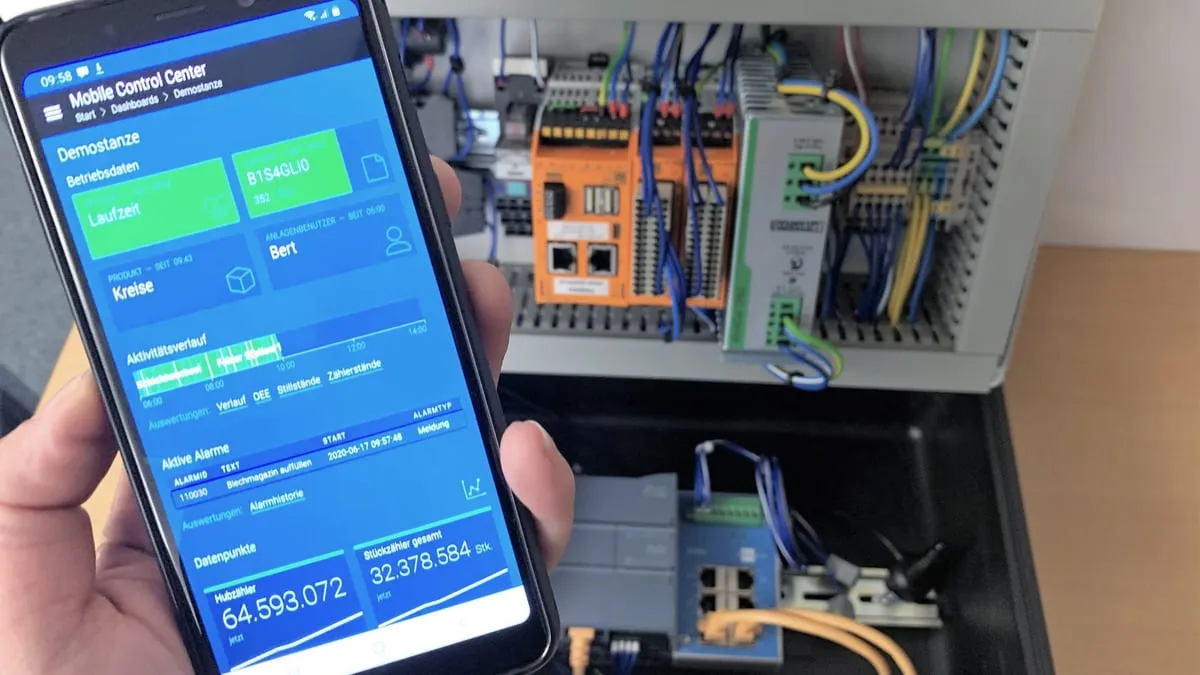
Production data on the smartphone
With the Control App, production data, activity history, active alarms and part counters are also available on the go, for example right at the control cabinet or on the night shift.
- Everything important on the goRunning time, current order, product and system user at a glance.
- NotificationsIf required, the app reports the state of unattended processes.
Non-destructive inline quality inspection
Detect defects early instead of sorting them out at the end: with inline quality inspection, parts are inspected directly in the running process, without contact and without damaging them. Cameras and sensors capture dimensions, surfaces and completeness. If the inspection detects a deviation, that message can become the starting point of the diagnosis before further work goes into defective parts.
- Non-destructiveEvery part can be inspected, not just samples.
- Detected earlyLess scrap and rework, because deviations show up immediately.
- From a single sourceIndustrial image processing at Eberle: planning and building the inspection systems as part of the system.
Frequently asked questions from production management
Question not listed? We will answer personally.
Ask a questionHow can machine downtime be reduced most effectively?
How does AiFixThat contribute to raising OEE?
How can changeover times be shortened?
How can the same faults be prevented from coming back?
It starts with a conversation.
About the system and about the fault that happens most often or costs the most. After that it is clear whether a proof of concept makes sense.
- Free & non-binding
- Live look at AiFixThat
- about 30 minutes
Choose date & time
Vienna time (CET/CEST) · 30 minutes · online meeting
Contact details
Appointment reserved!
We will get in touch shortly at and confirm the appointment with a meeting link.